

Three pillars: movement, relationship and awareness
This post uses two recent in person workshops as fodder to explore how we might create these all important moments of insight using three core pillars; movement, relationship and awareness.

I’m frying onions and sweet potatoes in a steel pan. The smell is wonderful, though I feel slightly rushed and anxious, mixed with simple excitement. I’m preparing for a workshop at my flat in Easton, Bristol. Eight people are about to arrive - and I’ve promised them soup together afterwards. It’s Tuesday evening, 6.15pm, and these folk have responded to the flyer below, one or two have read about the approach. It seems there is curiosity for this work and this is an exciting moment for me.
Having been thinking, researching, talking and writing about this approach to working with people I’m now, finally, actually doing it.
Here’s the FLYER…
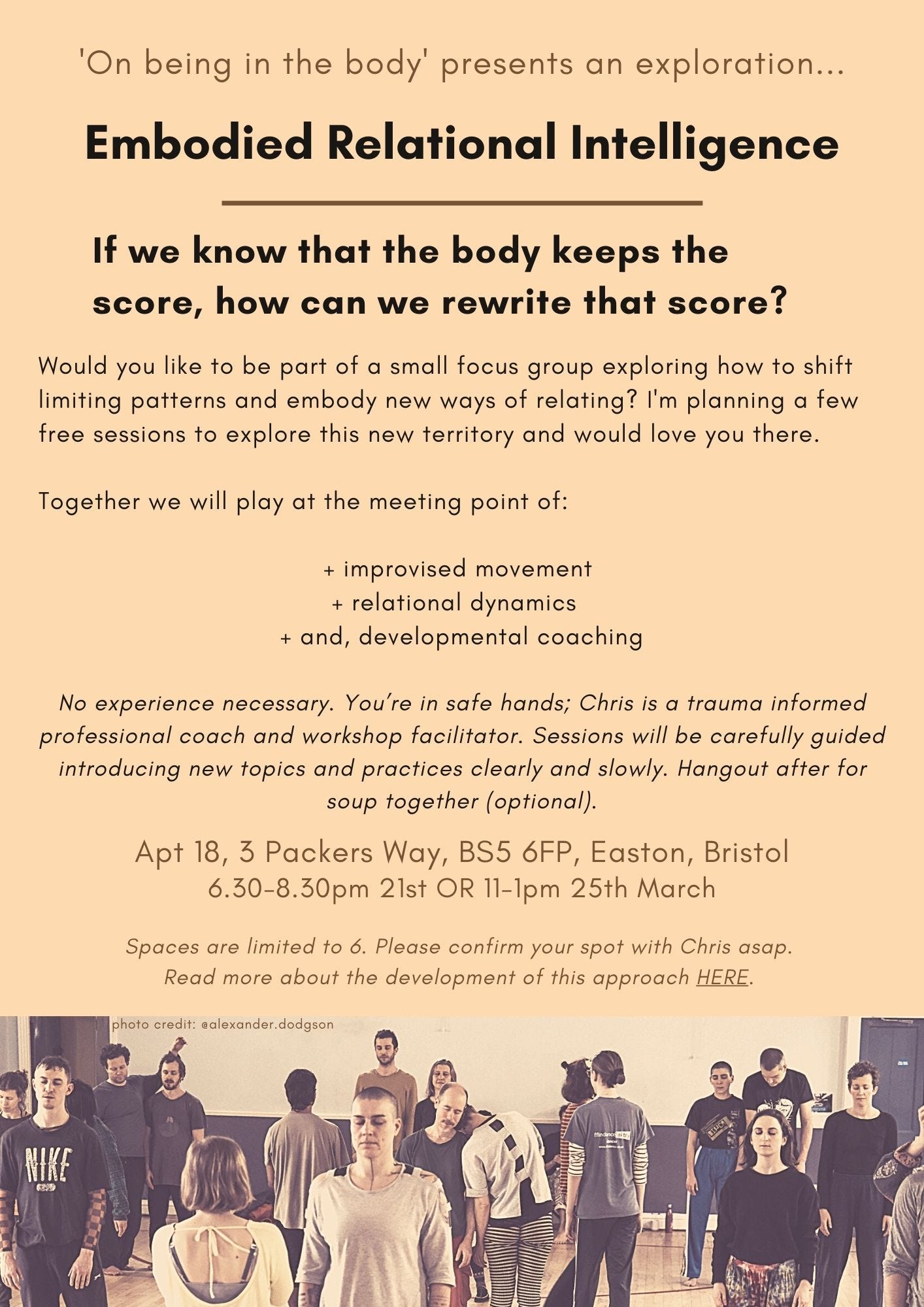
Embodied Relational Intelligence is, perhaps, a bit of a long-winded title, something shorter and simpler could work; though it is an accurate description of what we’re doing. We’re using embodiment practices (things we do with our bodies), in relationship with another person (sometimes close and in contact but not always), to help us notice patterns and shift through them (that’s the ‘intelligence’ bit). In simpler language it’s movement, relationship and awareness.
A little background to how we arrived here
As the flyer says; if we know that the body keeps the score, how can we rewrite that score?
Last week over dinner with my good friend Laura, we found ourselves asking this exact question. It seems important; if we are carrying trauma and wounding in our lives that the body holds, how can we rewrite that score into something more useful?
What I’m suggesting is that through embodiment practices we can notice our patterns and, in relationship with another person to help us, move through them and embody something different - this helps to rewrite the score.
‘The body keeps the score’ was the title of Bessel Van der Kolk’s seminal book that offered a profound reframing of the role of the body in our understanding and treatment of trauma.
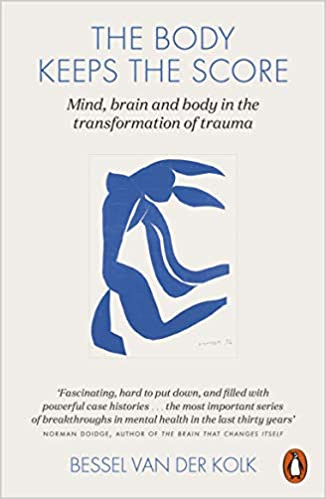
He suggests that:
“imprints from the past can be transformed by having physical experiences that directly contradict the helplessness, rage and collapse that are part of trauma.” (p4. ‘The Body Keeps the Score’)
His is an eloquent critique of the current widely accepted approaches to healing trauma; that you are either given talking therapy, or drugs that dampen the worst of the effects. Instead he suggests a more embodied approach:
“The act of telling the story (talking therapy) doesn’t necessarily alter the automatic physical and hormonal responses of the bodies… for real change to take place, the body needs to learn that the danger has passed and to live in the reality of the present.”
But how can we give our body the experience of living in the ‘reality of the present’, a clear sense that danger has passed? Thoroughly researched and insightful I find Van der Kolk’s work limited as there are few clear suggestions of ways to heal and develop ourselves, to do the all important rewriting.
My suggestion is that we can cook up the necessary conditions for healing trauma and healthy psychological development through carefully constructed experiences that create moments of insight and change. The conditions I’m currently working with are; movement, relationship and awareness.
These core conditions engage our bodies, help us notice patterns, and give us the opportunity to move through them. The patterns I’m referring to here revolve around some of life’s central themes such as; trust and dependency, giving and receiving, closeness and intimacy, leading and following.
Pillar 1: Movement
Movement practices help be present with what’s going on in and around our bodies. We could say these practices are helping us to become embodied by offering simple ways to bring attention to our bodies and to the ways that we meet another in physical and attentive ways.
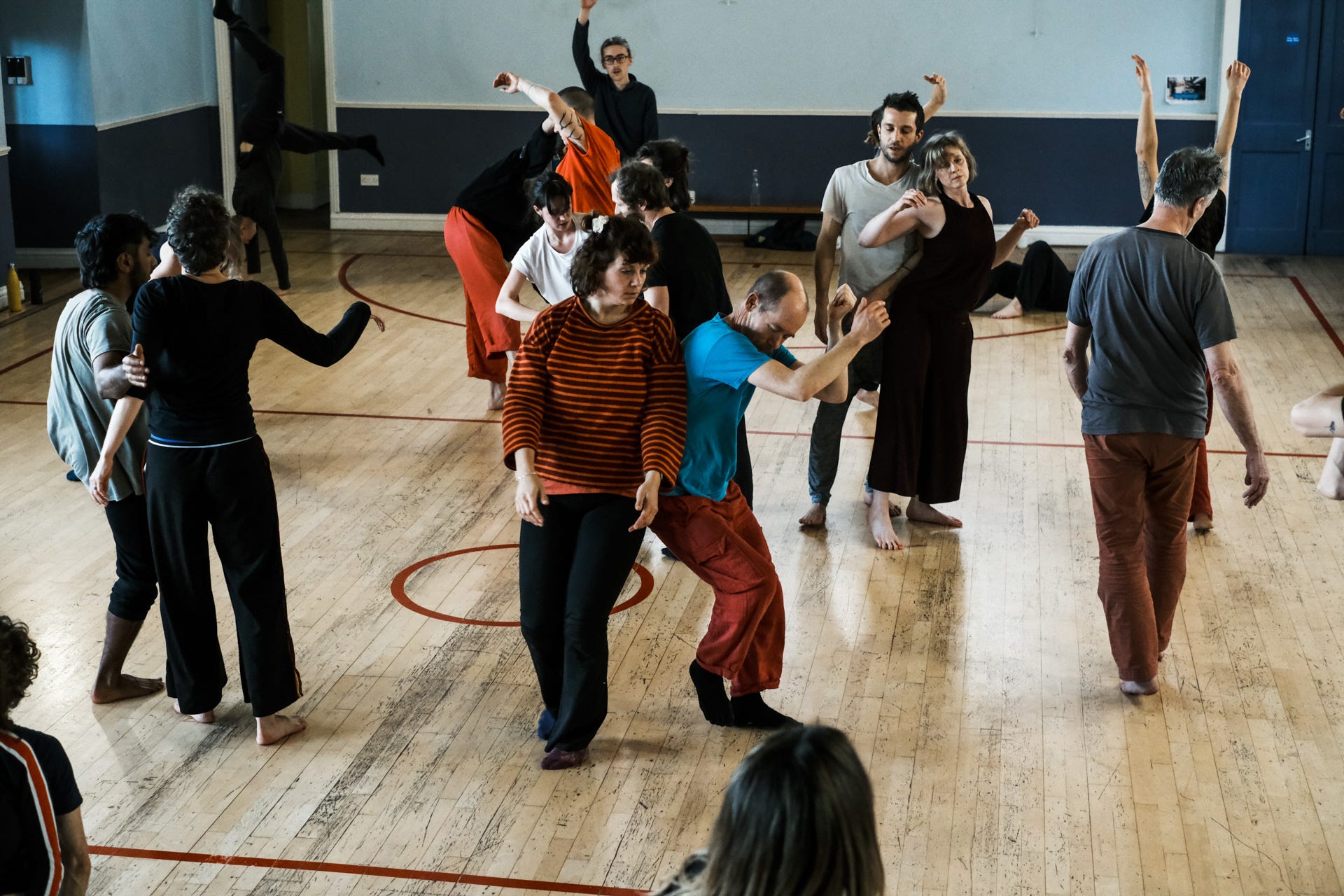
We do things like learn to share our weight with another person. This looks like a simple leaning exercise shoulder to shoulder with somebody of a similar height. We’re not doing any complicated lifting or technical exercises. If anything, the purpose is to strip back the physical exercise to a very simple form so that we can be attentive to the internal psychological dynamic that’s at play.
Other exercises we do involve meeting hands with another person and working to follow each other’s movements around the room. Through these exercises we work with relational dynamics like trust, giving, following, leading, playfulness, improvisation - these are some of life’s major themes and they’re all present here in the room when we’re attentive to them.
Movement, relationship and awareness. Super simple and yet profound and powerful. Awareness is brought into the room by inviting moments of reflective conversation.
Pillar 2: Awareness
Awareness means the use of conversation to help deepen and ‘move forwards’ the experiences we’re having by adding a layer of reflection and meaning making. (explaining subject-object shift)
I’m fascinated with the work of Robert Kegan and Jennifer Garvey Berger both of whom ground their work on adult development theory. The theory states that in order to make progress from one level of development to the next, we are required to make things object that we were once subject to. (The Evolving Self)
The subject to object shift suggests that we are subject to various stories, beliefs, thought patterns or ways of seeing the world and making sense of reality. (The Evolving Self) Being subject to these patterns means we are unconsciously operating from them, it’s as if we are operating from inside the pattern.
If we can move these patterns to something that we hold ‘as object’ then we gain a bit of cognitive space from the pattern, we learn to see it, to name it, to hold it outside of ourselves. This is the subject - object shift. If we can do this we are then granted agency and choice, we can choose to operate in a new a more harmonious or unified way. We have the pattern, as opposed to the pattern having us.
We use a small amount of conversation to shift our patterns from something that we’re subject to, to being something that we can hold as object. If you read this story you can get a sense of how this happens.
And so we regularly stop and I ask; what are you noticing about how you’re moving? What feels repetitive? What patterns can you notice? And how are these reflective of your life outside of this space?
By creating a safe space for this dialogue we can then choose a new way to move and thereby embody a different way of being.
We’re not spending lots of time digging into the story, we not trying to coach somebody into new ways of thinking, we’re not digging into the past and hoping for a healing experience once the full story is understood - instead we’re noticing the pattern, naming it briefly, and then practising to embody a new way of being.
Pillar 3: Relationship
The third and final pillar is relationship.
Working in this way affords us a chance to play with relational dynamics in an embodied way. ‘Each dance is like a conversation’ as my good friend Spence once said. Each meeting and moving with another is a micro relationship. In this simplified and striped back version of a relationship we get to see our patterns and ways of meeting.
Through the practices you can physically embody things like; boundaries, leading and following, meeting and being held, trust and commitment. And yet as the dance is happening in an improvised way there’s also something pre-verbal and precognitive about the ways that bodies meet and how these themes unfold.
You’ve a chance to lose yourself in the contact with your partner, to focus on the ways your bodies are meeting, to have this other person as a blank canvas of an ‘other’. It’s a rare opportunity that you get to relate with somebody in such an anonymous and yet caring and close way.
In exercises we might explore shapes, posture, movement patterns, ways of meeting, weight sharing and lifting. We might also explore physical and emotional needs and pains as starting points for exploration. We are engaged in a dance with another and in doing so we live into an immediate metaphorical experience of our ways of dancing through life.
Conclusion
And so there you have it; movement, awareness and relationship. It can seem simple, and yet in my world there are few people pulling together these ideas in a similar way. If you know of somebody working in this field then do please put us in touch as it’s always fun to exchange ideas.
In essence we are bringing reflective awareness to the physical practice of moving with another person. In doing so we can evaluate how things are happening by having a parallel conversion about what we’re noticing. This noticing helps us to then move through patterns into elevated (or deeper?) ways of relating.
Above all, let’s remember to make this practice, as with life, a dance. As Patrick Collaud say:
Key to our work is that we define it as a dance—a dance that allows both partners to feel safe within the interdependency, the playfulness, and the creatively performative.